 |
 |
| << Back Poser >> |
| Ghana’s declining fish stocks: Why marine protected area could be a game changer |
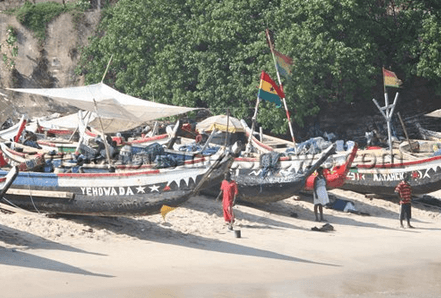 At dawn, fishermen at Apo community in the Shama Municipality of the Western Region push their wooden canoes into the sea with hope and increasing uncertainty.
For them, the sea that once guaranteed bumper catch now offers dwindling returns after a long fishing expedition. Mr Simon Dadzie, a fisherman, says: “Before, we were very sure of a good catch, but now, you can go the whole day and come back with almost nothing.” Ghana’s fisheries are in crisis. Marine stocks, especially small pelagic species like sardinella, mackerel, and anchovies that form the backbone of local diets are now dangerously depleted. Data suggests that over the past decade, Ghana’s total fish catch has declined by more than 17 per cent, with both artisanal and industrial sectors all recording sharp drops. Ghana’s fisheries sector contributes about one per cent to the county’s GDP, offering direct employment to 100,000 fishermen, and three million work force along the value chain. For Dadzie and many others who depend on the sea for survival, this decline is not just ecological, but also an existential threat. Some major causes of the decline Behind the decline lies a complex web of factors like overfishing driven by too many boats chasing few fish. Records show that about 70 per cent artisanal fishermen make up the fisheries sector, who have over 12,000 wooden canoes with outboard motors, in about 187 fishing communities with about 279 landing sites. In the semi-industrial sector, there are over 300 wooden boats with inboard engines at about seven landing sites, while about 45 industrial vessels with steel boats and inboard engines, and about 20 tuna vessels with steel boats and inboard engines landing at two sites each in the industrial sector. This means that both artisanal and industrial fleets have increased, intensifying competition in an already stressed waters. Illegal, Unreported, and Unregulated (IUU) fishing is another major factor that further worsened the situation. Practices such as light fishing, use of chemicals, and destructive gear are accelerating depletion, while weak law enforcement allows these infractions to persist. Research reveals that West African waters, including Ghana, are deemed to have the highest levels of IUU fishing in the world, representing about 40 to 60 per cent of the region’s catch. Dr Evans K. Arizi, a Lecturer at the Department of Fisheries and Aquatic Sciences, University of Cape Coast (UCC), said climate change also continued to wreak havoc on the marine stocks, noting that warm ocean temperatures alter fish migration patterns and reduce productivity in coastal waters. Consequences The consequences of all these factors are already visible. Ghana now imports over 79,000 metric tonnes of fish annually to meet local demand. Mr Kofi Agbogah, the Executive Director of Hen Mpoano, a non-governmental organisation (NGO) focused on coastal and marine ecosystem, stated that many of Ghana’s fish stocks are either overexploited or close to collapse due to declining catch sizes, fish being harvested younger, and entire breeding cycles being disrupted. He said continued depletion of marine stocks could pose a significant threat to the country’s food security, and the livelihoods of millions who depended on the sea for survival. According to him, despite existing regulations like the Fisheries Act, National Co-Management Policy, and Ratification of Ports States Measures Agreement among others, the situation continued to worsen. Marine protected area and its benefits Amid this crisis, Ghana has taken a bold move to establish its first Marine Protected Area (MPA) in the Greater Cape Three Points enclave in the Western Region, marking a major shift in its fisheries management. MPA functions as safe zones where fish can breed, grow, and replenish without human pressure, and over time, these protected populations can spill over into surrounding fishing areas, boosting catches and restoring balance. The MPA, which is set to be officially launched later this month, (April) will cover about 700 square kilometres of biodiversity-rich coastal waters in 21 communities designated as MPA zones. Globally, MPA managed well have shown the potential to rebuild depleted stocks and strengthen ecosystem resilience. Why MPAs could be a game changer It would replenish fish stocks. By protecting spawning and nursery grounds, MPA allows fish populations to recover naturally, and this is something that conventional rules and regulations alone have struggled to achieve. The MPA will also protect livelihoods. Healthier fish stocks mean better catches in the long run, and for coastal communities, this could translate into improved incomes and food security. It will combat illegal fishing methods. Clearly defined protected zones make monitoring and enforcement more targeted, helping to curb destructive practices. The MPA will also provide climate resilience. Stronger, more diverse marine ecosystems can better withstand climate shocks, from warming waters to habitat loss. However, the success of the MPA implementation depends heavily on enforcement, community involvement, and scientific planning. Without the buy-in from local fishers, and effective monitoring, the protected zones risk becoming existing in policy but failing in practice. In conclusion, there are imminent fears of Ghana’s fisheries being collapsed, therefore, the choices made today will determine whether future generations inherit empty sea or restored abundance. The establishment of the Marine Protected Area will offer an opportunity to reverse decades of decline, and represents a shift from exploitation to stewardship, from short-term survival to long-term sustainability. It will pave way for community-led management, giving coastal communities a stake in protecting the very resources they depend on. Source: GNA |
| Ghana Business News |
|
ECOWAS Bank approves over $267m for projects in Nigeria, Ghana, others The ECOWAS Bank for Investment and Development (EBID) has approved $266.7 million and another XOF30 billion to support a portfolio of strategic infrastructure projects in Nigeria, The Gambia, Ghana, Senegal, and Côte d'Ivoire. |
|
CBN, banks, fintechs launch joint platform to fix payment gaps •Unveil new payments vision as PSPC takes off By Babajide Komolafe The Central Bank of Nigeria (CBN), commercial banks and financial technology (fintech) operators have launched a joint industry platform aimed at addressing structural gaps in the nation’s payment system, even as the apex bank disclosed plans to unveil a new payments vision to drive the next […] |
|
World Bank approves $500m credit for Nigeria’s smallholder farmers The World Bank says it has approved a $500 million credit facility for Nigeria through the International Development Association (IDA) to support the implementation of the Nigeria Sustainable Agricultural Value-Chains for Growth (AGROW) project. In a statement on its website, the bank said the initiative is designed to increase smallholder farmers’ productivity, strengthen agricultural value chains, […] |
|
Cooking gas price rises 13% to N1,500 per kg …As dealers lament poor sales By Mariam Adebukola The price of Liquefied Petroleum Gas, LPG, also known as cooking gas has increased by 14.3 percent on a month-on-month, MoM, basis, to N1,500 per kilogram, from N1,300 recorded last month. However, the ex-depot price of the product increased by 16.7 percent on a MoM basis to N21 million […] |
|
Stakeholders call for inclusive, cross-border strategies to tackle insecurity in West Africa Stakeholders at a regional dialogue on peace and security have called for stronger collaboration, inclusive participation, and enhanced cross-border cooperation to address rising insecurity and violent extremism in West Africa. |
|
NNPC to increase crude oil supply to Dangote Refinery to seven cargoes By Udeme Akpan, Energy Editor The NNPC Limited has concluded plans to increase crude oil allocation to the Dangote Petroleum Refinery to seven cargoes in May 2026, up from the five cargoes supplied in previous months. The move, it was gathered, reflects NNPC’s commitment to prioritising domestic crude supply in the coming months. However, reacting in an […] |