 |
 |
| << Back Poser >> |
|
Liberia: Boakai Launches 285 Yellow Machines Operations To Improve Rural Roads, Calls For Maintenance Amid Public Criticisms
Business |
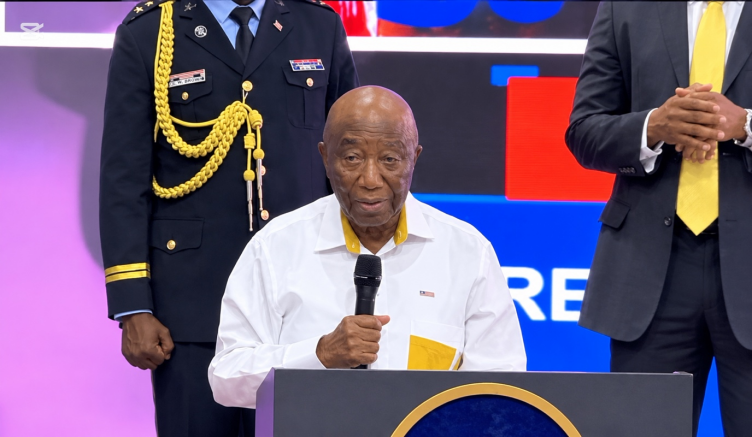 PAYNESVILLE, Montserrado County — President Joseph Nyuma Boakai has officially launched the nationwide deployment of 285 heavy-duty earth-moving machines intended to improve rural road connectivity across Liberia’s 15 counties, warning that poor maintenance and management could undermine the government’s investment.
By Emmanuel Weedee-Conway Speaking Monday at the state-owned Liberia Broadcasting System (LBS) in Paynesville, President Boakai described the initiative as a major infrastructure intervention aimed at rehabilitating feeder roads, connecting farming communities to markets, and improving access to essential services. However, amid persistent criticisms over the procurement process, the cost of the equipment, and its long-term sustainability, the President stressed that the success of the initiative would depend on professional management, technical training, accountability, and regular maintenance. The first consignment of the machines began arriving in February 2026, with the final batch delivered in May, bringing the total to 285. The equipment will operate through 19 strategic hubs serving all 15 counties. Transforming Rural Roads President Boakai said the deployment would help address longstanding transportation challenges that have isolated rural communities, increased the cost of moving agricultural products, and restricted access to healthcare and education. “We are launching the national deployment of 285 pieces of heavy earth-moving equipment, organized through 19 operational hubs serving all 15 counties of Liberia,” he announced. According to him, the equipment represents more than an investment in machinery, describing it as an investment in farmers, communities, and Liberia’s future. He recalled that poor road conditions, particularly during the rainy season, have made it difficult for farmers to transport their produce to markets, resulting in agricultural losses and higher food prices. “Sometimes we say people are lazy, but sometimes we need to create an enabling environment, something the people cannot do for themselves. Yet many farmers struggle to bring their harvest to market because of deplorable road conditions,” the President said. He added that the initiative would support the rehabilitation and maintenance of feeder roads, farm-to-market roads, and other routes across the country. Maintenance and Accountability While celebrating the deployment, President Boakai cautioned that acquiring the equipment was only the first step, emphasizing that maintaining the machines would determine whether the initiative delivers lasting results. “The acquisition of this heavy equipment is only the first step. The real challenge is to ensure that these machines remain operational, productive, safe, and properly maintained over many years,” he warned. He called for regular inspections, preventive maintenance, adequate resources, and technical training for operators and mechanics. “Heavy equipment is expensive. It is technically demanding and requires professional management. Without proper maintenance, even the best machine will eventually break down. My call is: maintenance, maintenance, maintenance,” he emphasized. Using a local example to illustrate what he described as a culture of neglect, the President said public assets must be handled differently. “Here in Liberia, we sometimes watch a car deteriorate—we wait for the wiper to fall off, then we wait for the bumper to fall off, then we kick it and say the car is still good. These machines must be maintained differently,” he stated. President Boakai said technicians must be trained, resources provided, and mechanical problems addressed before they develop into major failures. He tasked the Special Presidential Coordinating Committee (SPCC), working with relevant government institutions, with ensuring that professional operating procedures, maintenance schedules, technical support systems, and performance-monitoring mechanisms are established. The President also announced that counties would be periodically assessed based on their management and utilization of the equipment, with consideration given to rewarding those demonstrating strong performance. He called on the Ministry of Public Works, the Yellow Machines Board, the SPCC, and other responsible institutions to uphold transparency, efficiency, and operational discipline. Roads and Economic Opportunities Beyond improving transportation, President Boakai said the initiative was intended to strengthen agricultural production, expand economic opportunities, and improve food security. He maintained that better feeder roads would allow farmers to transport their produce more efficiently, reduce post-harvest losses, and connect previously isolated communities to economic activities. “A road is not merely a path between two places. It is a connection between people and opportunity. Every connected community can become more active in the national economy,” he said. The President stressed that the initiative’s success should be measured by the condition of Liberia’s roads and the economic opportunities created years after the launch, rather than the ceremony itself. “The true measure of success will not be this ceremony. It will be the condition of our roads five years from now, the number of roads built, and the agricultural opportunities created,” he added. He expressed appreciation to Vice President Jeremiah Kpan Koung, the late Minister of State for Presidential Affairs Sylvester Grigsby, the Ministry of Public Works, the Armed Forces of Liberia, the General Services Agency, and the SPCC team for their contributions to the initiative. He also charged operators, mechanics, and managers to handle the equipment responsibly, describing the machines as national assets intended to benefit all Liberians. Following his remarks, the President called out the counties as the machines were symbolically started, marking the formal launch of their nationwide operations. Procurement and Cost Controversies Despite the government’s celebration of the initiative, the Yellow Machines program has faced sustained criticism from lawmakers, opposition politicians, and civil society organizations since its announcement in 2024. Concerns have centered on the procurement process, financing arrangements, the total cost of the equipment, and whether the government complied with constitutional and public procurement requirements. Initially presented as a Special Presidential Project, the arrangement was subsequently described by the government as a “gentleman’s agreement.” Critics questioned compliance with Article 34(d) of the Liberian Constitution, which grants the Legislature authority over public borrowing, and demanded clarity about the suppliers and financing terms. In April 2025, Public Procurement and Concessions Commission (PPCC) Executive Director Bodger Scott Johnson told The Liberian Investigator that the commission had no record of involvement in the arrangement. “My office has no record to show that PPCC was involved in any part of the deal,” Johnson was quoted as saying. Lawmakers also demanded accountability. Representative Moima Briggs-Mensah of Bong County District #6 called for a full accounting of the initial batch of machines unveiled in 2024, while Representative Gizzie K. Kollince of Lofa County questioned whether a transaction of such magnitude could be negotiated without legislative concurrence. The advocacy group Solidarity and Trust for a New Day (STAND), headed by Mulbah K. Morlu, also warned that the acquisition must comply with procurement laws and constitutional requirements, arguing that bypassing competitive bidding or necessary legislative approval could expose responsible officials to legal liability. Meanwhile, Cllr. Moriah Yeakula of the opposition Alternative National Congress described the machines in February 2026 as “metaphors for empty spectacle,” arguing that development must produce tangible results beyond public displays. Anderson Miamen, Executive Director of the Center for Transparency and Accountability in Liberia (CENTAL), also questioned the need for additional management structures, including the SPCC and the Yellow Machines Board of Authority. He warned that establishing new structures could impose additional financial burdens on the government and divert resources from critical sectors such as education, healthcare, and agriculture. Sustainability and Government Response Financial concerns have further intensified the debate. Initial estimates placed the cost of the 285 machines between US$79 million and US$85 million. The government later announced that it had renegotiated the arrangement to approximately US$22 million under a three-year payment structure. However, a technical white paper by the Engineering Society of Liberia, presented by its President, David D. Wounuah, estimated that the initiative’s lifecycle costs could reach approximately US$238 million, with annual operating expenses projected at US$21.6 million, including fuel costs across the 19 operational hubs. The report warned that without effective monitoring and expenditure controls, recurring operational costs could place considerable pressure on public finances and threaten the program’s sustainability. The government, for its part, has maintained that no public funds were disbursed under the initial arrangement. Officials have also said that the first batch of 35 machines, which arrived in 2024, was returned as part of a restructuring of the original arrangement, after which the procurement was renegotiated. The government has further maintained that the revised arrangement was aligned with national laws and procedures. With all 285 machines now formally launched for nationwide deployment, the Boakai administration faces the challenge of translating its infrastructure promises into measurable improvements in rural connectivity. Ultimately, the initiative’s success will depend not only on the number of roads rehabilitated but also on transparent management, effective maintenance, and whether rural communities experience lasting economic and social benefits. Editorial note: The article is approximately 1,000 words. Before publication, verify the financial figures, the Engineering Society’s projections, and the government’s claims about procurement compliance against the original documents. |
| FrontPage Africa |
|
Ghana secures $2b investment in petroleum agreements Ghana has secured about $2 billion in additional investments from partners in the Jubilee and Tweneboa-Enyenra-Ntomme (TEN) oil fields to boost production following the extension of the respective petroleum agreements to the end of 2040. |
|
Ghana government to invest $10b in economic transformation from 2027 to 2030 The Ghana government says it will invest $10 billion in an economic transformation programme from 2027 to 2030, targeting agriculture, energy, critical minerals and other productive sectors. |
|
Liberia: Boakai Launches 285 Yellow Machines Operations To Improve Rural Roads, Calls For Maintenance Amid Public Criticisms PAYNESVILLE, Montserrado County — President Joseph Nyuma Boakai has officially launched the nationwide deployment of 285 heavy-duty earth-moving machines intended to improve rural road connectivity across Liberia’s 15… |
|
Breaking the raw material curse: How Techiman’s new cashew factory redefines Ghana’s export future In a significant boost to Ghana's industrialisation drive and agricultural value addition, President John Dramani Mahama has commissioned a state-of-the-art 100-metric-tonne-per-day cashew processing factory in Techiman, Bono East Region. |
|
Ghana to invest $200m in nuclear power readiness programme Ghana will invest $200 million in a 24-month programme to prepare the country for the construction of its first nuclear power plant. |
|
Ghana said to receive up to 62 tonnes of mercury annually through illicit channels Ghana receives between 42.5 and 62 tonnes of mercury annually through illicit channels for use in artisanal and small-scale gold mining, stakeholders have disclosed. |