 |
 |
| << Back Poser >> |
|
Cedi was worst African currency in quarter 2, 2026 – World Bank
Business |
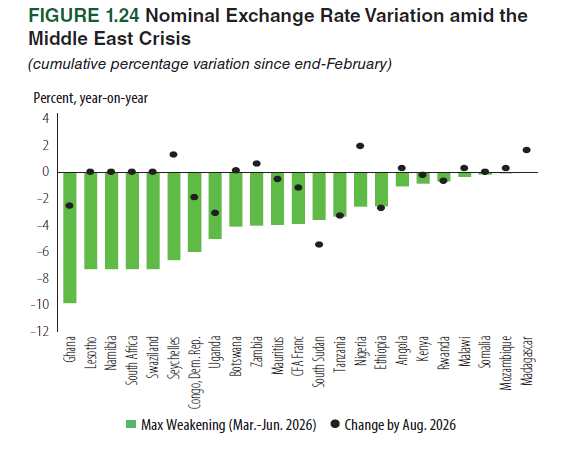 Amid the Middle East conflict, the Ghana cedi was the worst currency in Africa, depreciating nearly 10% to the US dollar between March 2026 and June 2026, the World Bank has revealed in its October 2026 Africa Economic Update.
It was followed by Lesotho loti (over -6%), Namibia dollar (over -6%), South Africa rand (over -6%) and Swaziland lilangeni (over -6%). According to the World Bank, the escalation of the conflict in the Middle East initially exerted broad-based pressure on African currencies. “Most countries with available daily exchange rate data recorded currency depreciations during the second quarter of 2026 relative to end-February, before the conflict intensified. In seven of the 22 countries monitored (excluding the CFA franc zone), the maximum depreciation exceeded 5.0%, including in the Democratic Republic of Congo, Ghana, the Seychelles, and South Africa”. “By end-August, however, much of this pressure had eased, with only 10 currencies remaining weaker than their end-February levels”, it added. It continued that the exchange rate response reflected the interaction of external shocks and preexisting domestic vulnerabilities, stressing, the sharp increase in oil and energy prices raised import bills across net energy-importing economies, increasing demand for U.S. dollars, weakening reserve positions, and intensifying depreciation pressures. At the same time, heightened geopolitical uncertainty triggered a flight to safety in global financial markets, prompting capital reallocation away from emerging and frontier economies. The World Bank said supply disruptions in the Middle East also pushed up the cost of key agricultural inputs, including fertilizers, adding to imported inflation pressures. It added that the currency depreciation further amplified fiscal vulnerabilities in countries with significant external debt service obligations, as the local-currency cost of servicing U.S. dollar-denominated debt increased. Meanwhile, the cedi remained under pressure over the last two weeks, extending its year-to-date depreciation against the US dollar to 10.04%. In the interbank market, the currency weakened by 1.39% to GH¢11.62 to a US dollar but gained 0.70% and 0.47% against the pound and euro to GH¢15.40 and GH¢13.24, respectively. Retail forex market performance was similarly mixed, with the cedi appreciating 0.21% against the US dollar and 0.91% against the euro to GH¢11.93 and GH¢13.73, respectively. It weakened 0.31% against the pound to GH¢15.88. |
| MyJoyOnline |
|
Naira depreciates to N1,362/$ in parallel market The Naira yesterday depreciated to N1,362 per dollar from N1,357 in the parallel market on Monday. |
|
West Africa must modernise agriculture for food security – Experts Experts have called for the urgent modernisation of agriculture across West Africa, stressing the need to move beyond increased production and focus on transforming agricultural value chains to ensure food security and improved nutrition amid growing climate and population pressures. |
|
Climate change threatens Nigeria’s food systems as farmers count losses ….experts call for urgent, sustainable measures to mitigate impacts By Gabriel Ewepu ABUJA — Nigeria’s food system is facing growing threats from climate change as erratic rainfall, prolonged dry spells, flooding, rising temperatures, pests and diseases disrupt farming activities, slash yields and leave farmers counting losses running into billions of Naira. The situation, according to […] |
|
World Bank: Fuel price to slow Nigeria’s poverty reduction •Says rising pre-election spending may derail reforms •Raises Nigeria’s 2026 growth forecast to 4.3% •Projects 15.7% inflation rate for 2026 •44% of firms in Nigeria, Kenya adopt AI, power constraints threaten gains By Babajide Komolafe, Economy Editor The World Bank has warned that elevated fuel prices could slow Nigeria’s poverty reduction efforts despite an expected […] |
|
Government releases GH¢9.1b covering six quarters of DACF to MMDAs – Ayariga Mr Mahama Ayariga, the Minister of Local Government, Chieftaincy and Religious Affairs, has announced government's release of GH¢9.1 billion, covering six quarters of the District Assemblies Common Fund (DACF) to Metropolitan, Municipal, and District Assemblies (MMDAs) nationwide. |
|
Cedi was worst African currency in quarter 2, 2026 – World Bank According to the World Bank, the escalation of the conflict in the Middle East initially exerted broad-based pressure on African currencies. |